

Learning how to recover stolen bitcoin is critical if you’ve lost cryptocurrency to theft, hacking, or scams. Unlike traditional bank fraud, where you can file a chargeback, cryptocurrency operates on immutable blockchains with no central authority to reverse transactions. However, that same transparency can work in your favor.
In this comprehensive guide, we’ll walk you through exactly how to recover stolen Bitcoin, what to do if your Bitcoin has been stolen, how the recovery process actually works, and when you need professional blockchain forensic help.
Time-sensitive note: If your Bitcoin was stolen in the last 24-48 hours, skip to the First 24 Hours Action Plan section immediately. Speed dramatically increases your chances of learning how to recover stolen bitcoin successfully.
How to Recover Stolen Bitcoin: Is It Actually Possible?
The short answer: sometimes, yes — but it depends on several critical factors.
According to data from the FBI’s Internet Crime Complaint Center (IC3), victims who take action within the first 72 hours have a significantly higher recovery rate than those who wait weeks or months.
What Makes Learning How to Recover Stolen Bitcoin Possible?
Bitcoin’s blockchain is completely transparent — every transaction ever made is publicly visible and permanently recorded. While wallet addresses are pseudonymous (not directly tied to real identities), the transaction trail itself cannot be erased or hidden.
This means professional blockchain forensic analysts can:
- Trace stolen Bitcoin through multiple wallet hops
- Identify when funds land on cryptocurrency exchanges
- Work with exchanges to freeze accounts holding stolen funds
- Coordinate with law enforcement for legal asset seizure
Our team has recovered over $12.5 million in stolen cryptocurrency since 2018 using these exact techniques. (See our recent $180K Bitcoin recovery case study for a real-world example.)
When Is Bitcoin Recovery NOT Possible?
Let’s be honest about the limitations:
- ❌ Funds mixed through privacy protocols: Services like CoinJoin, Wasabi Wallet mixers, or conversion to Monero make tracing extremely difficult
- ❌ Peer-to-peer cash-outs: If scammers sold your Bitcoin directly for cash (LocalBitcoins, etc.) with no exchange involved, there’s no entity to freeze funds
- ❌ Decentralized exchange (DEX) swaps: DEXs have no central authority to contact for freezes
- ❌ Very old thefts (2+ years): Funds are likely long gone or cashed out by this point
- ❌ Tiny amounts (under $5,000): Recovery costs may exceed the stolen amount
However, even if full recovery isn’t possible, partial recovery or tracking the scammer for law enforcement purposes may still be valuable.
What to Do in the First 24 Hours (Critical Action Plan)
If your Bitcoin was stolen recently, time is your most valuable asset. Follow these steps immediately:
Step 1: Stop All Activity (0-15 minutes)
Do NOT:
- Send more Bitcoin, trying to “unlock” or “verify” your account
- Click on any recovery service links from unsolicited emails
- Pay anyone who promises guaranteed recovery for an upfront fee
- Accept help from random people on Reddit, Telegram, or Twitter DMs
Why? Recovery scams target theft victims. Scammers monitor blockchain transactions and phishing victim lists, then pose as “recovery experts” to steal even more money from their victims. According to CoinDesk research, crypto recovery scams grew 340% in 2024.
Step 2: Document Everything (15-60 minutes)
Gather and save the following information immediately:
- Transaction ID (TXID): The unique identifier for the Bitcoin transfer. You can find this in your wallet’s transaction history.
- Wallet addresses: Both your wallet address (where Bitcoin was sent FROM) and the scammer’s address (where it was sent TO)
- Exact date and time: When the unauthorized transaction occurred
- Amount stolen: How much Bitcoin was taken (in BTC and USD value at time of theft)
- Screenshots: Any emails, websites, chat logs, or social media messages related to the scam
- How it happened: Write a detailed timeline of events (phishing email? fake exchange? romance scam? investment fraud?)
Pro tip: Use Blockchain.com’s explorer to look up your transaction. Enter your TXID and screenshot the entire transaction page — this shows the flow of your Bitcoin and is critical evidence.
Step 3: File Official Reports (1-3 hours)
Even if you don’t think law enforcement can help, filing official reports is essential for later exchange freeze requests.
A) File an FBI IC3 Report
Go to www.ic3.gov and file a complaint. This creates an official federal record of your theft. The FBI’s Internet Crime Complaint Center tracks cryptocurrency fraud and coordinates with international authorities.
What you’ll need:
- Your personal information
- Description of the scam
- Financial transaction details (TXID, wallet addresses)
- Scammer’s contact information (if known)
B) File a Local Police Report
Visit your local police department and file a theft report. Many officers won’t understand cryptocurrency, so bring:
- Printed screenshots of your blockchain transaction
- A written statement explaining what happened in plain English
- Your IC3 complaint confirmation number
Ask for a case number — you’ll need this for exchange freeze requests.
C) Report to the Exchange (If Applicable)
If your Bitcoin was stolen from an exchange account (Coinbase, Binance, Kraken, etc.), contact their support immediately:
- Report unauthorized access
- Request account freeze
- Ask for transaction logs
- Enable 2-factor authentication if you haven’t already
Step 4: Contact a Professional Recovery Service (3-24 hours)
This is where most victims make a crucial decision: attempt DIY recovery or hire professionals.
When DIY makes sense:
- Small amount (under $5,000)
- You understand blockchain explorers and can trace transactions yourself
- Funds are still in the initial scammer wallet (haven’t moved yet)
When professional help is needed:
- Significant amount ($10,000+)
- Funds have already moved through multiple wallets
- Scammer used an exchange (you’ll need legal freeze requests)
- Theft occurred through sophisticated phishing or hacking
Professional services like Crypto Recovery Expert Agency use enterprise-grade blockchain forensic tools (Chainalysis, Elliptic, TRM Labs) that aren’t available to the public. Our team includes former Chainalysis analysts and financial crime prosecutors who can:
- Trace funds through complex transaction chains
- Identify exchange deposit addresses
- Prepare legal freeze requests with proper documentation
- Coordinate with exchange compliance teams globally
Red flags to avoid: Legitimate recovery services never guarantee results, never ask for upfront payment of the full stolen amount, and never request your private keys or wallet passwords.
How to Recover Stolen Bitcoin: The Technical Process Explained
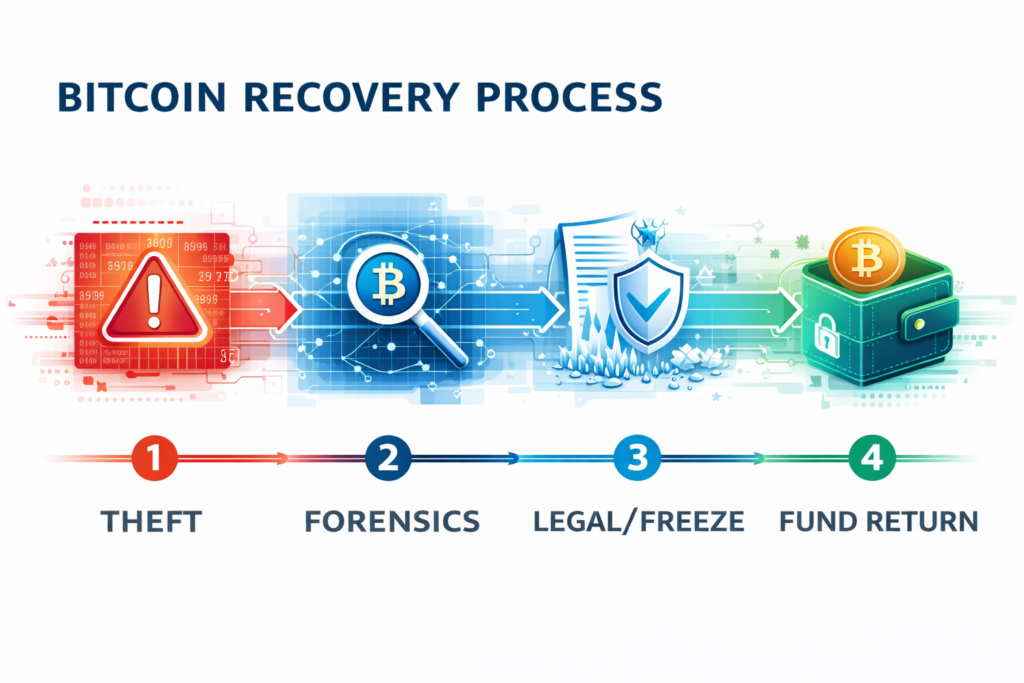
Here’s what happens behind the scenes when professionals show you how to recover stolen bitcoin through blockchain forensic analysis:
Phase 1: Blockchain Forensic Analysis (Days 1-7)
Using specialized software, forensic analysts map the entire transaction flow:
- Input analysis: Identify the source wallet (your wallet)
- Output analysis: Track where the Bitcoin went after leaving your wallet
- Hop tracing: Follow funds through multiple intermediate wallets (chain hopping)
- Clustering: Group related wallet addresses controlled by the same entity
- Exchange identification: Detect when funds land on known exchange wallets
This process can take anywhere from a few hours (simple case) to several days (complex multi-hop transactions).
What you’ll learn: Exactly where your Bitcoin went, how many wallets it touched, and whether it’s landed somewhere recoverable (like an exchange).
Phase 2: Exchange Identification & Verification (Days 7-14)
If forensic analysis shows your Bitcoin entered a cryptocurrency exchange, recovery becomes significantly more likely.
Exchanges leave distinct blockchain signatures:
- High-volume wallet addresses (hundreds of deposits daily)
- Published deposit addresses in exchange documentation
- Characteristic transaction patterns (consolidation wallets, cold storage transfers)
Once an exchange is identified, the team verifies:
- Which specific exchange it is (Binance, Kraken, KuCoin, etc.)
- What jurisdiction it operates in (matters for legal requests)
- Whether the account holding your Bitcoin is still active
According to Chainalysis research, 78% of major exchanges comply with properly documented freeze requests when presented with law enforcement support.
Phase 3: Legal Freeze Request (Days 14-30)
This is where legal expertise becomes critical. Recovery teams prepare freeze requests that include:
- Blockchain evidence (transaction flow diagram)
- Police report and case number
- The victim signed the affidavit
- Proof of ownership (original purchase records for the Bitcoin)
- TXID linking the theft to the exchange deposit
Exchanges evaluate these requests based on:
- Strength of blockchain evidence
- Quality of legal documentation
- Timeliness (recent thefts get priority)
- Law enforcement involvement
If approved, the exchange freezes the account holding your funds — preventing the scammer from withdrawing.
Phase 4: Fund Return Process (Days 30-90)
Once funds are frozen, the exchange’s compliance team works to return them:
- Verification of ownership: You must prove that the Bitcoin is yours
- KYC compliance: Your identity must be verified
- Legal clearance: Exchange confirms no legal conflicts
- Transfer execution: Funds returned to your verified wallet
Timeline varies by exchange:
- US/European exchanges: 14-30 days typically
- Asian exchanges: 20-45 days (may require translated documentation)
- Smaller exchanges: 30-60 days (less sophisticated compliance processes)
Success Rates: What Are Your Actual Chances?
Based on our team’s 200+ recovery cases since 2018, here are realistic success rates by scenario:
| Scenario | Success Rate | Typical Recovery % |
|---|---|---|
| Theft under 72 hours, funds on exchange | 75-85% | 40-80% of the stolen amount |
| Theft 1-4 weeks, funds on exchange | 50-65% | 20-60% of the stolen amount |
| Theft 1-3 months, funds partially moved | 30-45% | 10-30% of the stolen amount |
| Theft 6+ months, funds mixed/cashed out | 5-15% | 10-30% of stolen amount |
| Funds never hit an exchange (P2P only) | Under 10% | Varies widely |
Key takeaway: The sooner you act, the better your chances. Every day matters.
How Much Does Bitcoin Recovery Cost?
Legitimate recovery services operate on a success-based fee model:
- No recovery = no fee: You don’t pay unless funds are actually returned
- Typical fee: 15-25% of the recovered amount
- Upfront consultation: Some firms charge $500-2,000 for initial blockchain analysis (refunded if recovery succeeds)
Warning signs of scams:
- ❌ Asking for 50%+ of the stolen amount upfront
- ❌ Guaranteeing 100% recovery
- ❌ Requesting your private keys or seed phrase
- ❌ Unwilling to provide verifiable credentials or references
- ❌ Pressuring you to act immediately without explanation
At Crypto Recovery Expert Agency, we charge 20% of successfully recovered funds only. If we don’t recover your Bitcoin, you pay nothing beyond the initial consultation fee (which we waive in most cases).
Common Mistakes That Hurt Recovery Chances
Avoid these errors that sabotage recovery efforts:
1. Waiting Too Long
Every hour that passes gives scammers more time to move, mix, or cash out your Bitcoin. The blockchain trail doesn’t disappear, but actionable opportunities do.
2. Falling for Recovery Scams
Victims who send additional Bitcoin to “recovery services” lose even more money and complicate the original recovery case.
3. Attempting DIY Blockchain Tracing Without Expertise
Using public blockchain explorers is fine for basic tracking, but without professional tools (Chainalysis, Elliptic), you’ll miss critical transaction patterns, exchange identifications, and mixer detection.
4. Not Documenting the Theft Properly
Missing screenshots, incomplete police reports, or lost TXIDs make legal freeze requests nearly impossible to execute.
5. Alerting the Scammer
Confronting the scammer directly (via email, social media, etc.) often causes them to immediately move funds to harder-to-trace wallets.
What If You Can’t Afford Professional Recovery?
If professional services are out of reach financially, here are free/low-cost options:
- File comprehensive reports: IC3, local police, and the exchange involved. Sometimes this alone results in freezes.
- Use public blockchain explorers: Blockchain.com, Blockchair, and WalletExplorer can help you trace basic transaction flows.
- Contact exchanges directly: If you identify which exchange holds your Bitcoin, contact their fraud/compliance team with your evidence. Some exchanges act on well-documented cases even without legal representation.
- Join victim communities: Reddit’s r/CryptoScams and specialized forums sometimes have volunteers who help with basic blockchain analysis.
However, be realistic: complex recoveries involving international exchanges, legal documentation, and multi-hop tracing almost always require professional expertise.
Preventing Future Bitcoin Theft After Learning How to Recover Stolen Bitcoin
Once you’ve successfully learned how to recover stolen bitcoin and dealt with a theft, take these steps to prevent it from happening again:
- Hardware wallets only: Move Bitcoin to Ledger, Trezor, or other hardware wallets — never leave large amounts on exchanges
- Enable 2FA everywhere: Use authenticator apps (Google Authenticator, Authy), never SMS-based 2FA
- Verify URLs manually: Bookmark exchange sites and type URLs directly — never click email links
- Use unique passwords: Every account needs a different strong password (use a password manager like Bitwarden or 1Password)
- Cold storage for HODLing: Long-term Bitcoin holdings should be in cold wallets, completely offline
- Educate yourself on scams: Follow CoinDesk’s scam coverage to stay updated on new tactics
Get Expert Help Learning How to Recover Stolen Bitcoin
Now that you understand how to recover stolen Bitcoin, if your Bitcoin was stolen and you meet these criteria:
- ✅ Theft occurred within the last 90 days
- ✅ Amount stolen is $10,000 or more
- ✅ You have transaction IDs and wallet addresses
- ✅ You haven’t already paid for a “recovery service” that failed
…then professional recovery is worth pursuing.
Get a free case assessment from our team. We’ll trace your initial transaction, identify whether recovery is feasible, and give you an honest evaluation — no cost, no obligation.
Our team includes:
- Arnold Stuetz: Former Chainalysis Senior Blockchain Forensic Analyst with 12+ years in cybersecurity
- John Stuetz: Former San Diego County Financial Crime Prosecutor with 10+ years prosecuting fraud cases
We’ve recovered over $12.5 million for clients worldwide. Learn more about our team.
No upfront recovery fees. No false promises. Just expert blockchain forensics and proven legal coordination.
This guide is updated monthly to reflect the latest recovery techniques and scam trends. Bookmark this page for future reference. Last updated: February 2026.